Between April and May each year, in the small towns of Odumase-Krobo and Somanya in Ghana’s Eastern Region, something happens that has no Western equivalent. Young Krobo women — typically between fifteen and twenty-five — enter a week-long initiation that will transform them, publicly and spiritually, from girls into women. This is Dipo, the Krobo rite of womanhood, and it is one of the most visually striking and culturally significant ceremonies in all of West Africa.
If you have seen photographs of Ghanaian women draped in layers of handmade glass beads — yellow for wealth, blue for tenderness, white and blue together for femininity — those images almost certainly came from a Dipo ceremony. The beadwork alone can weigh up to 25 kilograms. But Dipo is not a fashion show. It is a spiritual passage, a community event, and a window into a culture that has maintained this practice for centuries despite colonialism, Christianity, and modernity.
The History and Meaning of Dipo
The origins of Dipo are tied to the Krobo people’s relationship with Klowem, the sacred stone that sits at the heart of the ceremony. According to Krobo oral tradition, the rite was established to ensure that young women entered marriage as spiritually prepared, socially educated, and community-endorsed adults. It was never merely symbolic — it was the mechanism through which Krobo society maintained its standards of womanhood across generations.
The ceremony has survived because of what it represents to the Krobo: continuity. When a young woman completes Dipo, she is not just celebrating herself. She is joining a line of women stretching back centuries, each of whom sat on the same sacred stone, wore the same styles of beads, and danced the same Klama steps. In a country where many traditional practices have been abandoned or commercialized, Dipo remains remarkably intact.
Christianity has had an uneasy relationship with Dipo. Some churches have discouraged participation, viewing elements of the rite — particularly the virginity testing — as incompatible with Christian values. But for most Krobo families, the two coexist. You will see families attend Dipo on Saturday and church on Sunday without any sense of contradiction. The rite predates Christianity in Ghana by centuries, and most Krobo consider it a cultural practice rather than a religious one.
1 App.
Plan. Book. Explore Ghana.
- Plan your trip with AI
- Book experiences & stays
- Grab event tickets
- Earn & redeem rewards
- $50 airport chauffeur
- 24/7 trip support


When Dipo Happens
Dipo is held annually between April and May. The exact dates are set by the Konor (paramount chief) and traditional council of Manya Krobo. The ceremony spans approximately five to seven days, with the final “outdooring” — the public presentation of the newly initiated women — being the climactic event that draws the largest crowds.
If you are planning to attend, contact the Akwaaba team in advance. We confirm dates with the traditional council each year and can arrange guided access to the public portions of the ceremony.
What Happens During the Seven Days
Day 1: Entering Seclusion
The initiates are taken to a ritual house where they shed their childhood clothing. Their heads are shaved — a symbolic act of leaving behind their former selves. They are then bathed in the river, a cleansing that is both physical and spiritual, intended to purify them for the transformation ahead.
Days 2–5: Training and Preparation
For the next several days, the initiates live together under the guidance of elder women called kpanlogo-yo. This is the part of Dipo that outsiders rarely see, and it is arguably the most important. The training covers:
- Domestic skills — cooking traditional Krobo dishes, household management, the economics of running a home
- Sexual education — frank instruction about sex, contraception, childbirth, and nurturing, delivered by women who have lived it
- Social conduct — how to carry yourself as a Krobo woman, how to resolve conflicts, how to support other women in your community
- The Klama dance — the traditional dance that each initiate must perform publicly on the final day. Learning the Klama is not optional; it is the visible proof that a woman has completed her training.
Day 5–6: The Sacred Stone
This is the most spiritually charged moment of the entire ceremony. Each initiate is brought to the Klowem stone — a sacred rock that has been central to Krobo spiritual life for as long as anyone can remember. The initiate sits on the stone in a specific ritual posture. According to Krobo belief, the stone “accepts” women who have maintained their virginity and rejects those who have not.
This aspect of Dipo is controversial, and visitors should approach it with cultural sensitivity rather than judgment. The practice reflects values that are deeply embedded in Krobo identity, and debating them as an outsider misses the point of witnessing the ceremony. You are there to observe and learn, not to impose external standards.
Day 7: The Outdooring
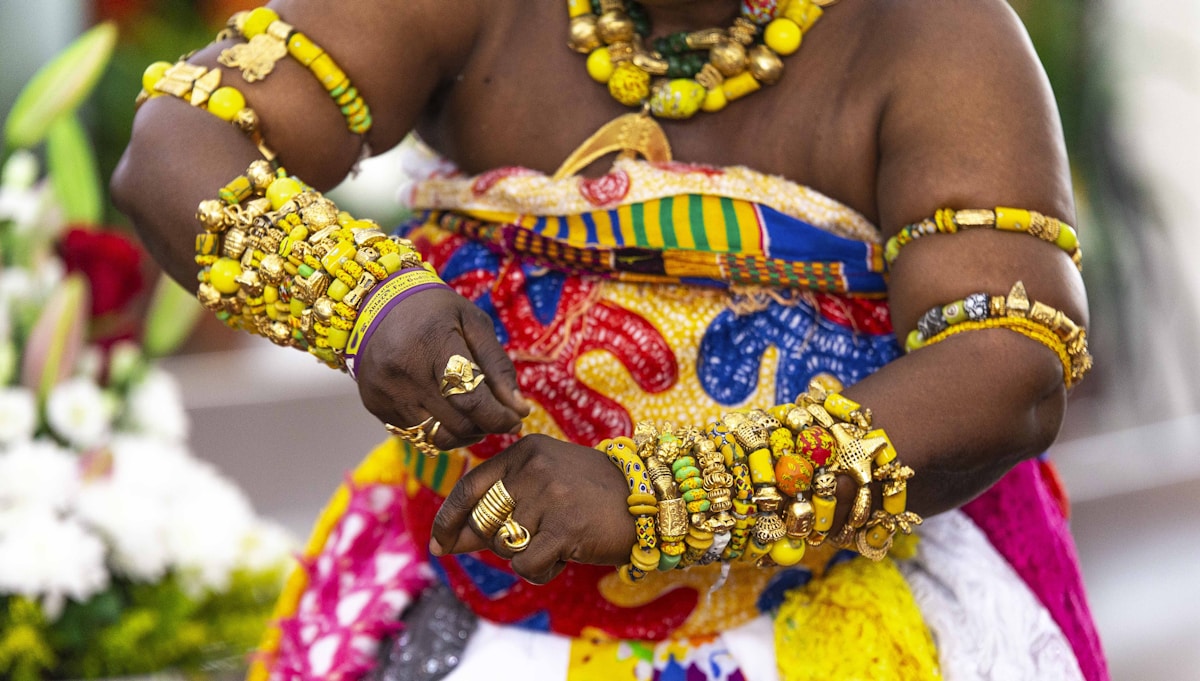
The final day is the public celebration. The initiates emerge from seclusion dressed in their full beadwork — and the beadwork is extraordinary. Multiple strands of handmade glass beads in specific color combinations are layered around the neck, waist, wrists, and ankles. A single initiate’s bead ensemble can weigh 20–25 kilograms and represent months of preparation by the family’s bead makers.
The women then perform the Klama dance publicly for the first time. The community gathers — hundreds or thousands of people — and the atmosphere is somewhere between a graduation ceremony and a wedding reception. There is drumming, singing, feasting, and genuine joy. The newly initiated women are congratulated, blessed by elders, and formally welcomed into adult Krobo society.
The Significance of Krobo Beads
You cannot understand Dipo without understanding Krobo beads. The Krobo are among Africa’s oldest and most renowned glass bead makers, with a tradition that predates European contact. Krobo beads are not decorative accessories — they are a language. Each color, pattern, and combination communicates specific social information:
- Yellow (bodom) — wealth, maturity, prosperity, long life
- Blue (koli) — “something you love very much” — affection, tenderness
- White + blue — femininity, purity
- Red — spiritual protection, power
- Green — fertility, growth, new beginnings
Krobo bead-making is recognized by UNESCO as a significant intangible cultural heritage. If you visit Odumase-Krobo, you can tour bead-making workshops where artisans demonstrate the grinding, molding, and firing process. It makes an excellent addition to a Dipo visit — and the beads make meaningful souvenirs that directly support local craftspeople.
Where to Experience Dipo
Dipo takes place in Odumase-Krobo and Somanya in the Manya Krobo district of the Eastern Region.
Getting There
- From Accra: 65 km north, approximately 1.5 hours by road via the Accra-Koforidua highway. The road is paved and in good condition.
- Public transport: Trotros run regularly from Accra’s Tudu station to Odumase-Krobo. Cost is approximately GHS 30–40 (about $3).
- By private car: Straightforward drive. Parking is available in town but can be congested during the outdooring day.
Accommodation
Odumase-Krobo has limited hotel options — a few guesthouses in the GHS 100–200/night range. For more comfortable accommodation, Koforidua (the Eastern Regional capital, 30 minutes away) has better options including the Capital View Hotel. Alternatively, Dipo is close enough to Accra for a day trip if you leave early.
What to Bring
Cash (no ATMs accept international cards reliably in Odumase), sunscreen, water, and modest clothing. Women should cover their shoulders. If you plan to buy beads, bring GHS 200–500 depending on quality and quantity.
Photography and Etiquette
The outdooring day is photographable — families actively photograph and video their daughters. However:
- Always ask before photographing individuals, especially close-ups of initiates
- The sacred stone ceremony is generally not open to outside photography
- Do not enter the seclusion house
- Dress modestly — this is a spiritual event
- If an elder asks you to stop filming, stop immediately
Combining Dipo with Other Experiences
The Eastern Region offers several experiences that pair well with a Dipo visit:
- Krobo bead-making workshops — watch artisans create beads using traditional methods, and purchase directly from makers
- Shai Hills Resource Reserve — a small but rewarding wildlife reserve with baboons, antelope, and hiking trails (40 minutes from Odumase)
- Boti Falls — twin waterfalls in the Eastern Region, a 1-hour drive from Odumase
- Heritage Trail tour — combine Krobo culture with Cape Coast Castle and other historical sites
Visit with Akwaaba
Akwaaba arranges guided cultural tours timed to the Dipo ceremony. Our Krobo-speaking guides provide cultural context, handle logistics, and ensure you experience Dipo respectfully and meaningfully. Browse our packages or contact us for a custom Eastern Region itinerary.
Frequently Asked Questions
Is Dipo open to visitors?
The outdooring (final day) is a public celebration and visitors are welcome. Earlier stages, especially the sacred stone ceremony, may be restricted. Having a local guide is essential for navigating access.
How much does it cost to attend?
There is no entrance fee. You may be asked for a small donation to the traditional council (GHS 50–100 is appropriate). Buying beads or food from local vendors is expected and appreciated.
Is the virginity testing real?
Yes, the sacred stone ritual is still practiced. Visitors should respect this as a cultural practice and avoid making judgments. If this aspect concerns you, focus your visit on the outdooring day, which is purely celebratory.
Can men attend Dipo?
Men attend the outdooring and public celebrations. The training and seclusion days are women-only. Male visitors are welcome at the durbar and dance performances on the final day.
What’s the best way to get there from Accra?
Private car or arranged transport is ideal (1.5 hours). Trotros are cheap but slow. Contact Akwaaba for arranged transportation as part of a festival tour package.
EVENTS IN GHANA
What's On in Ghana This Week
Festivals, concerts, cultural events, and experiences — updated every week.
Browse Events →
Lock in your Ghana trip for just $100 down
Flights, vetted stays, local guides and SanlamAllianz insurance — all handled. Reserve your spot with $100, pay the balance later.
FROM @AKWAABA.APP
See What Ghana Actually Looks Like
Our six latest posts on Instagram