Plan your Ghana trip
Don’t just read about it. Go.
Akwaaba plans and books Ghana trips for diaspora travelers. Free AI itinerary in 60 seconds — or WhatsApp our team to get a custom quote today.
Picture this: you’re standing on a narrow suspension bridge 30 meters above the forest floor in Kakum National Park, the canopy alive with movement, and a Chocolate-backed Kingfisher lands three feet from your face. That’s the kind of moment Ghana delivers to birders willing to make the trip. This is a country where a single morning walk can produce 40 species before breakfast — and where one particular bird, the White-necked Rockfowl, draws serious listers from every corner of the world.
Ghana sits in the heart of the Upper Guinea forest zone, one of the world’s biodiversity hotspots, and it shows. Over 750 bird species have been recorded here. That puts Ghana firmly among West Africa’s finest birding destinations — arguably the most accessible of them. Infrastructure has improved dramatically, English is widely spoken, and the country has a reputation for safety and warmth that makes logistics far less stressful than in many neighboring countries.
Why Ghana for Birdwatching?
The case for Ghana starts with habitat diversity. In the south you have lowland rainforest, and in the north you get Guinea savanna and dry woodland. In between there’s a mix of forest-savanna transition zones, coastal lagoons, wetlands, and agricultural land. Each habitat type brings its own bird community. You can see flamingos at a coastal lagoon in the morning and Bateleur Eagles over open savanna in the afternoon. Not many countries give you that range in a single trip.
Ghana also has a handful of species found nowhere else in the world, or nearly so. The Ahanta Francolin is a West African forest bird whose range runs from Sierra Leone to Benin, and Ghana is one of the best places to find it. The Copper-tailed Glossy Starling, Yellow-throated Olive Greenbul, and White-spotted Flufftail all have ranges heavily centered on this part of West Africa. For a serious lister, these birds alone justify the airfare.
Then there’s the practical reality: Ghana is easy. Accra’s Kotoka International Airport has good connections from Europe and the US. The main birding sites are reachable by road. Local guides, when you hire a good one, are extraordinarily knowledgeable — they grew up with these forests and can locate birds by ear in ways that would take a foreign visitor years to develop.
EVERYTHING HANDLED FOR YOU
Akwaaba Covers the Full Trip — Not Just the Tour
The Holy Grail: White-necked Rockfowl
The White-necked Rockfowl — Picathartes gymnocephalus — is one of Africa’s most wanted birds, full stop. It belongs to a family so ancient and so distinct that taxonomists have argued for decades about where to put it. The bird itself looks like something out of mythology: a crow-sized creature with a ghostly white body, black wings, and a naked yellow-and-black head. It nests in colonies on rock faces inside forest, typically on overhanging granite boulders, and it bounces across the forest floor like it owns the place.
Ghana is one of the best countries in the world to see Rockfowl. Ankasa Conservation Area in the southwest is the most reliable site — the birds are well-habituated and local guides know the nesting colonies intimately. There are also sites in the forest around Kakum and a few lesser-known locations that good local guides can take you to. The birds are most predictable at the nest sites, particularly in the breeding season (roughly November through March).
One thing to understand: you cannot find Rockfowl on your own. This is a bird you see with a local expert who knows the specific boulder, the specific colony, and what time of day the birds are most active. Don’t attempt it without local help — you’ll almost certainly miss it.
Top Birding Sites in Ghana
1. Kakum National Park
Kakum is Ghana’s most famous national park and, for birders, the canopy walkway changes everything. Seven bridges strung between platforms 30 meters above the forest floor put you at eye level with the canopy — a perspective you simply cannot get from the ground. Forest species that would otherwise be distant silhouettes in the treetops become close, observable, identifiable.
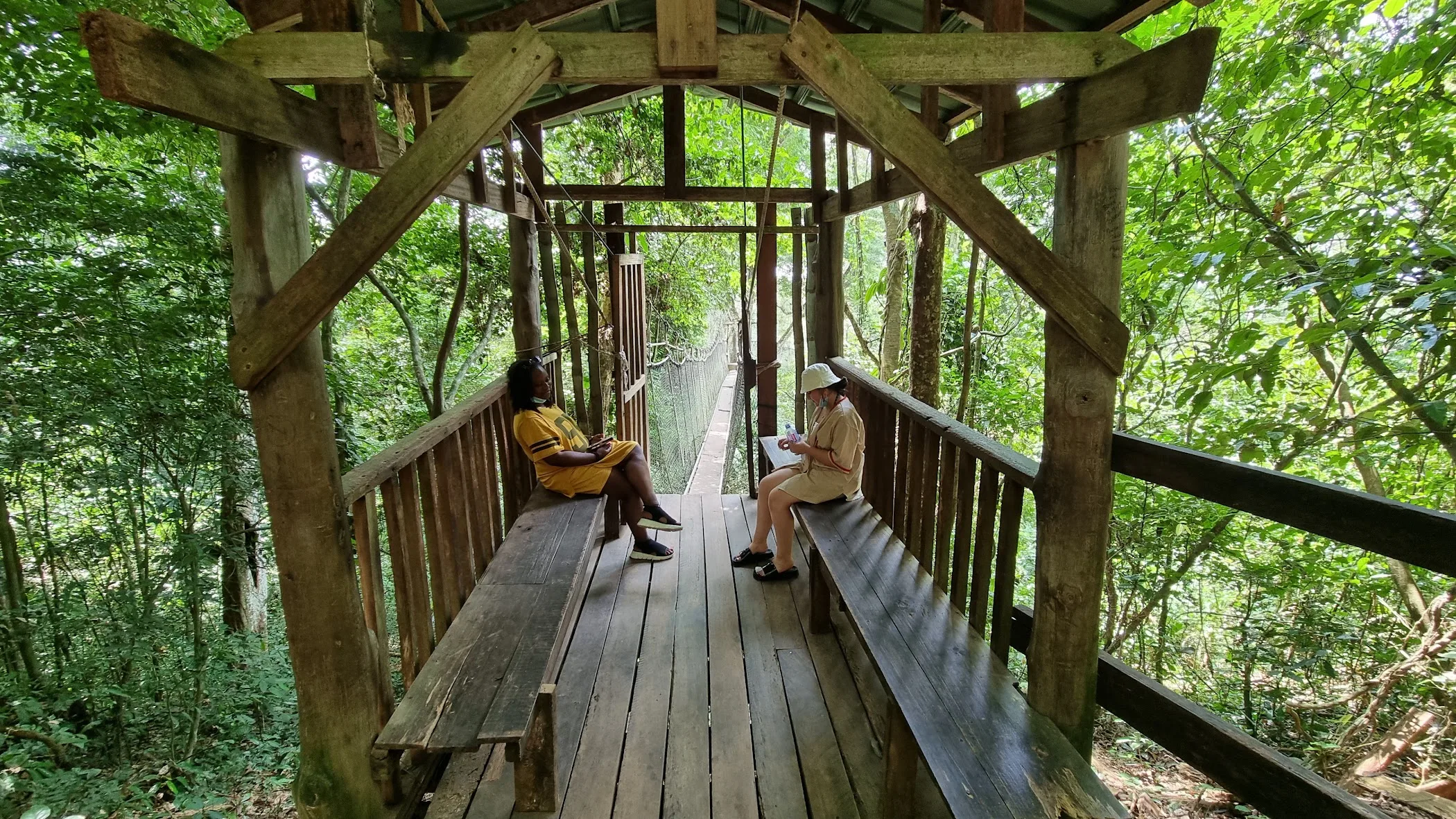
The park has several hundred species on its list. Target birds include the Chocolate-backed Kingfisher, African Piculet, White-crested Hornbill, and the Ahanta Francolin, which is best looked for on early morning walks along the forest trails. Go early. The walkway is usually quiet before the tour groups arrive around 9am.
2. Mole National Park
Mole is a very different experience from the southern forest sites. This is dry savanna and Guinea woodland in northern Ghana, and the bird community shifts completely. Over 300 species recorded. The star attractions are the large birds you get in open country: White-backed Vulture, Bateleur Eagle, Abyssinian Ground Hornbill walking across the road like it has somewhere important to be. At night, the Standard-winged Nightjar — the male in breeding plumage has elongated wing feathers that flutter in display. It’s surreal.
Mole also has Elephants, Warthogs, Kob, and occasionally Lions, which makes it the obvious choice for combining birding with a wildlife safari. Sit at the lodge waterhole at dusk with binoculars and you’ll rack up species without walking a meter.
3. Bobiri Butterfly Sanctuary
Bobiri, near Kumasi, is criminally undervisited by foreign birders. It’s a small patch of semi-deciduous forest managed primarily as a butterfly reserve, but the birding is excellent. The forest is mature, well-preserved, and quiet. Yellow-casqued Wattled Hornbill is possible here. African Dwarf Kingfisher — one of the smallest and most jewel-like of the kingfishers — occurs in the undergrowth. Because few birders come here, the birds have less human pressure and tend to be more approachable.
4. Atewa Range Forest Reserve
Atewa is one of Ghana’s most important forests for threatened species, with significant conservation battles ongoing due to mining pressure. The Rufous Fishing Owl is the prize bird here — secretive, nocturnal, and genuinely difficult, but experienced local guides know where to look. Atewa holds a good selection of Upper Guinea endemics and is worth a full day or overnight.
5. Keta Lagoon (Volta Region)
Keta Lagoon is unlike anywhere else in Ghana. The lagoon system near the Togo border is large, shallow, and seasonally host to enormous concentrations of waterbirds. The flamingo flocks are the headline — up to 10,000 Greater Flamingos at peak times. Beyond flamingos, you’ll find African Spoonbill, Black-tailed Godwit, various sandpipers and terns, and a resident Pied Kingfisher population that seems to number in the hundreds. A scope is very useful here.
6. Shai Hills Resource Reserve
Shai Hills sits about 45 minutes from Accra and works well as a day trip or a first-morning site. The reserve covers rocky inselbergs and dry scrub. Raptors perch on exposed rocks. The Abyssinian Roller is often conspicuous. It’s accessible, pleasant, and produces species you won’t find in the southern forests.
7. Ankasa Conservation Area
Ankasa is the White-necked Rockfowl site in Ghana. It’s in the far southwest, close to the Ivory Coast border, protecting some of the finest remaining lowland rainforest in the country. Plan at least two nights — the driving time from Accra is significant, and you want full days in the forest to justify the journey.
Planning a Ghana birding trip?
Akwaaba builds custom birding itineraries: multi-site routes, local expert guides, logistics sorted. Book a free 30-minute planning call.
Related: Kakum National Park
Related: Wildlife in Ghana: Best Parks, Animals & Safari Guide (2026)
Best Time to Go Birding in Ghana
November through April is the prime window. This is the dry season, and it brings two big advantages: vegetation thins out as deciduous trees drop leaves in the north, improving visibility considerably, and Palearctic migrants are present. From November to February you’ll encounter warblers, flycatchers, and raptors that have flown down from Europe and Central Asia to winter in West Africa.
March and April are still good. Migrants start moving north, but resident species are becoming more active as breeding season approaches. The light in the mornings is beautiful and the heat hasn’t yet reached its punishing peak.
The wet season (May to October) isn’t a write-off. Birding is harder — vegetation is lush and dense — but some species are only active or visible during breeding season. If you’re visiting for other reasons and want to squeeze in some birding, you absolutely can.
Essential Field Guides and Apps
The definitive printed reference is “Birds of Ghana” by Nik Borrow and Ron Demey, part of the Helm Field Guides series. It covers all recorded species with detailed plates and maps.
For a digital option, the Roberts Bird Guide app is worth having on your phone. It includes calls, which is invaluable when you’re trying to identify something singing unseen in dense forest. Merlin from Cornell Lab is increasingly useful in West Africa as its sound ID coverage improves. eBird is the obvious tool for trip planning — pull up the hotspot pages for Kakum, Mole, Keta Lagoon, and the other sites before you travel.
What to Pack
Binoculars first. Minimum 8×42 — the larger objective lens gathers more light, which matters in dark forest conditions. 10×42 works well for open-country sites like Mole and Keta. If you’re going to Keta Lagoon, a telescope and tripod are worth the luggage hassle.
Clothing: long sleeves and long trousers for the forest. Muted colours — olive, khaki, grey — are better than bright colours. Comfortable, worn-in walking shoes with good ankle support. Get on malaria prophylaxis before you travel — this is non-negotiable. Carry insect repellent with DEET and use it.
Planning Your Ghana Birding Tour
A realistic itinerary for a first Ghana birding trip is 10 to 14 days. A possible structure: fly into Accra, morning at Shai Hills to get your eye in, then head south to Kakum (2 nights minimum, ideally 3), across to Ankasa for Rockfowl (2 nights), back through Bobiri near Kumasi (1 night), then north to Mole (2 nights). If your schedule allows, add a day at Atewa and a day at Keta Lagoon. That’s 10 to 12 days of birding, well-structured, with genuine targets at each site.
Hiring a local guide for the whole trip rather than piecemeal guides at each site has real advantages. A good Ghana birding guide knows all the sites, can adjust the itinerary based on recent conditions, and builds up an understanding of your pace and interests. The quality of your guide has more impact on your species total than almost any other factor.
Frequently Asked Questions
How many bird species does Ghana have?
Ghana has over 750 recorded bird species, making it one of West Africa’s most species-rich birding destinations. The combination of lowland rainforest in the south, Guinea savanna in the north, and coastal wetland habitats along the Gulf of Guinea contributes to this diversity.
Is Ghana good for birdwatching?
Yes — and genuinely so, not just as a consolation prize. Ghana has several species that are high priorities for serious birders worldwide, including the White-necked Rockfowl, multiple Upper Guinea endemics, and excellent representation of West African forest and savanna species. It’s also one of the easier West African countries to travel in.
Where can I see the White-necked Rockfowl in Ghana?
Ankasa Conservation Area in the southwest is the most reliable site. There are also locations in and around the Kakum area. In all cases, you need a knowledgeable local guide to find the nesting colonies — this is not a bird you can locate independently. The best time is the breeding season (roughly November to March).
Do I need a guide for birdwatching in Ghana?
For most sites, a guide will dramatically improve your experience and species total. For the White-necked Rockfowl specifically, a local guide is essential — you will not find the nesting colonies without one. The best Ghana birding guides are excellent naturalists; their knowledge of forest birds by ear alone is worth the cost many times over.
Planning a Ghana birding trip?
Akwaaba builds custom birding itineraries: multi-site routes, local expert guides, logistics sorted. Book a free 30-minute planning call.
Plan Your Ghana Trip
- Ghana Vacation Packages
- Detty December 2026 Packages
- Heritage Trail Tour
- Food Tasting Tour
- Things to Do in Ghana
- Best Time to Visit Ghana
- First-Time Visitors Guide

Akosua Adoma is Akwaaba’s Marketing Manager and Ghana travel specialist. She has spent years exploring Ghana’s most iconic destinations — from the Cape Coast dungeons to the canopy walkways of Kakum — and helping diaspora travelers reconnect with the continent. She oversees Akwaaba’s content strategy, community partnerships, and brand storytelling.
Visit it — with a guide who knows the way
Don’t just read about it. Akwaaba’s curated, all-inclusive trips bring these places to life with verified local guides, transport, stays and a $50 airport chauffeur pickup.
Lock in your Ghana trip for just $100 down
Flights, vetted stays, local guides and SanlamAllianz insurance — all handled. Reserve your spot with $100, pay the balance later.
FROM @AKWAABA.APP
See What Ghana Actually Looks Like
Our six latest posts on Instagram